- Role
- Co-founder, Product Designer
- Timeline
- Jan - July 2025
- Status
- Beta launch in App Store (Shut down Jul 2025)
Co-founding a kitchen inventory management app
The Bet
Households throw away groceries they meant to use, because nobody has time to keep track of what's in the fridge and when it'll go bad. My co-founder Rohan and I recognized an opportunity here and bet that a smart kitchen inventory app that's swift enough to use as you put away your groceries could help aid this.
Key Features
What we built
Scan your grocery receipt to add items to inventory
Snap a photo of the receipt, review what it picked up, and the whole grocery run lands in your inventory with expiry dates attached. No typing items in one by one, the chore that makes people give up on tracking in the first place.
Accurate expiration tracking
Most apps treat shelf life as a fixed number. We factored in where an item is stored (fridge, freezer, or pantry) and whether it's been opened, since these impact shelf life dramatically. That made our expiry dates more accurate than our competitor's (which was validated by side-by-side tests as well as user feedback). Users could still override any date by hand.
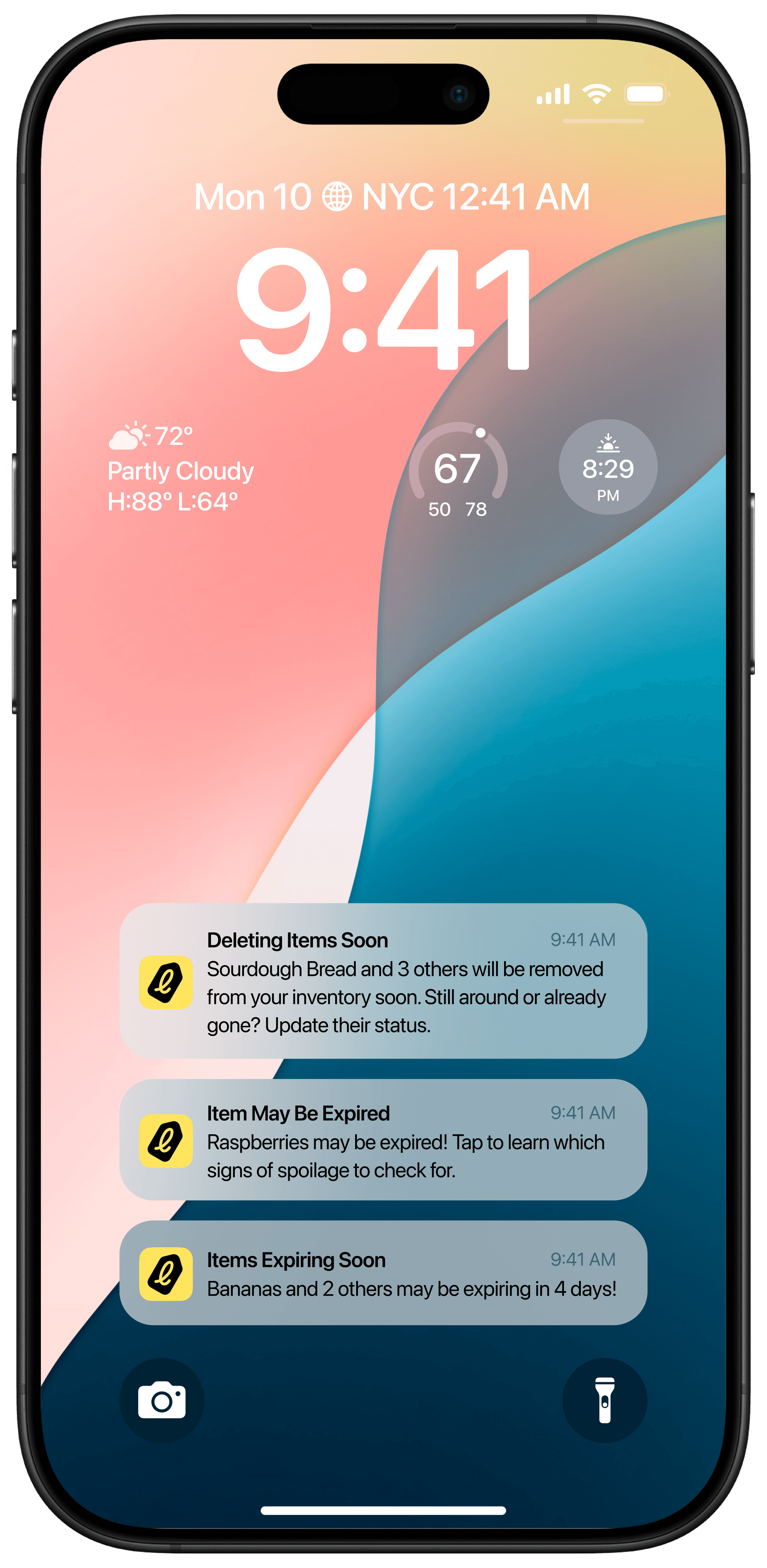
Reminders went out a week before an item expired, two days before, on the day, and three days after. Items expiring together were grouped into one notification, and despite the cadence, most users didn't feel over-notified. Users who wanted a different rhythm could customize the schedule.
Personalized recipes
Pick the items from your inventory you want to use up and Laybel finds recipes built around them. Finding recipes for ingredients about to go bad, without having to leave the app, made it much easier to save groceries from ending up in the bin.
Market Validation
What we learned from a closed launch on the App Store
We did a closed launch on the App Store in May with about 50 testers, which validated the need for a product like ours. 75% of users were still logging groceries and using the app for tracking and recipes after the first week.
Most feedback clustered around three things: expanding our database to cover more items (rarer grocery items, international foods, etc.), fixing bugs where receipt scanning missed some items, and letting users choose how soon after expiry items get cleared from their inventory.
But the biggest opportunity we found next was a voice interface, which would make adding and removing items, asking for recipes, and overall app usage far easier.
The Call
Why we ultimately shut Laybel down
We hadn't built monetization yet, since the beta was there to validate the need, not charge for it. Around that time, I was offered the founding designer role at QuantLink AI, and Rohan, my co-founder, joined as founding engineer.
For a while, we continued building Laybel on the side, working through the feedback from our testers and on a beta of the voice interface. But we were doing this in parallel to our growing responsibilities at QuantLink. A few months in, QuantLink started to require a 100% of our time, as we were part of the founding team building from 0 to 1 there as well. So we decided to wind Laybel down deliberately, rather than let it stall.
Reflection
Laybel made me a better founding designer
- Building a real app from 0 → 1, with real users pushed me to sharpen both my product design and my lean startup strategy.
- I owned and built the design system in a way that scaled across fast iterations and new features.
- I learned to balance wanting every design detail to be perfect with meeting the deadlines needed to operate at startup speed.